
Laurinburg Criminal History Checks
Laurinburg criminal records do not sit in one office. The Laurinburg Police Records Division handles department reports and citation help. Scotland County detention creates the booking record, and the Scotland County Clerk of Superior Court maintains the criminal case. A personal fingerprint-supported North Carolina record comes from the SBI Right to Review process. Start close to the event, then move outward only when the question calls for a wider record.
- Ask Laurinburg Police Records for the city incident, arrest, crash, or citation record and confirm whether it can be released.
- Give the incident number, date, place, names, record type, desired format, and any need for a certified copy.
- Check Scotland detention for booking status and use North Carolina eCourts for the filed criminal case.
- Confirm the charge outcome or obtain a certified disposition from the Scotland County Clerk.
- For a fingerprint-supported review of your own state history, follow the North Carolina SBI subject-review channel.
A Laurinburg name match is only a lead. Compare the report number, booking identifier, court file number, date, and charge-level outcome before treating records as connected.
Laurinburg Police Records Counter
The city publishes a concrete route for Laurinburg police reports. Records operates Monday through Friday from 9 a.m. to 5 p.m. at 303 West Church Street. Staff process department reports, provide copies to walk-in requesters, record traffic citations, and help locate court dates. Call 910-276-3211 before a trip to confirm that the Laurinburg record is ready, releasable, and available in the requested form.
No separate online request form or public fee schedule was verified. A clear Laurinburg request should state the incident number if known, event date and time, street or location, report type, names and the requester’s role, contact details, preferred format, and certification need. Asking about eligibility and cost first can prevent a wasted visit. Investigative narratives, protected identities, juvenile data, and other restricted content may be withheld or redacted even when basic event facts can be released.
Laurinburg Police Records
303 West Church Street
Laurinburg, NC 28352
910-276-3211
Monday–Friday, 9 a.m.–5 p.m.
Records at the Laurinburg Police Department
The Laurinburg Police Department is the city custodian for reports created by its officers. The city identifies Mitchell Johnson as chief and describes patrol, detectives, school resource officers, K-9, Special Resource Team, gang unit, animal control, and Citizens on Patrol. Those units may contribute to a Laurinburg incident file, but the Records Division remains the practical public entry point.
A Laurinburg police report is not a full criminal history. It documents the Laurinburg event and the department’s response. It may predate a prosecutor’s final charge or a court disposition. For a Laurinburg matter that reached court, pair the police record with the Scotland County case file. For countywide context beyond Laurinburg, the broader Scotland County criminal history overview explains which custodian owns each product.
Laurinburg NIBRS Record Trail
Laurinburg offers a rare look at what happens after a city report is written. Records staff use Southern Software Police-Pak and submit National Incident-Based Reporting System data to the SBI. The transmitted categories include offense classification and scoring, case clearances, property values, arrest counts, and corrections. This flow helps explain how Laurinburg activity contributes to state crime statistics without turning an incident report into a statewide rap sheet.
- Classification
- The offense category used for statistical reporting, which is not necessarily the final court charge.
- Clearance
- A reporting status showing how an incident was resolved for NIBRS purposes, not a finding of guilt.
- Correction
- An update sent when report data must be fixed after its first submission.
- Arrest count
- A statistical measure that should not be read as a count of Laurinburg convictions.
The SBI 2024 viewer lists 1,037 index offenses reported by Laurinburg Police. That total includes 10 murder, 9 rape, 24 robbery, 238 aggravated assault, 244 burglary, 455 larceny, and 57 motor-vehicle theft reports. These are offenses known to the reporting agency. They are not convictions, unique people, or a measure of risk for one Laurinburg neighborhood.
Booking and Arrest Records in Laurinburg
A Laurinburg arrest can produce three records in quick succession. The city officer creates the arrest or incident report. Scotland County detention creates the booking entry after intake. A magistrate and the clerk create the judicial papers and case file. The original arrest charge may later be amended, dismissed, or replaced, so a Laurinburg booking should never be treated as proof of conviction.
For recent custody, use the Sheriff’s official Citizen Connect Current Confinements and Daily Report tools, then call Scotland detention at 910-277-3166 when a Laurinburg result is missing or time-sensitive. The agency filter may contain variant names. A failed Laurinburg agency search does not prove that no booking exists. Try the date or name route, then confirm the booking number, bond, charge, and next court date through official channels.
County detention is not a Laurinburg city jail, and NCDAC custody is different again. State prison, probation, parole, and post-release results belong in the NCDAC Offender Public Information system. The city report remains with Laurinburg Police.
Laurinburg Records in Three Buildings
The location of a Laurinburg record follows its purpose, not merely the place of arrest. The city counter holds department-created reports. The detention operation at Biggs Street holds booking and custody data. The Scotland County Clerk at the courthouse holds the filed case, hearings, judgment, and disposition. Although the sheriff, detention, magistrate, and courthouse functions are physically close, their records remain legally distinct.
| Laurinburg question | First custodian | Best identifier |
|---|---|---|
| What did the officer report? | Laurinburg Police Records | Incident or arrest number |
| Was the person booked? | Scotland detention | Booking number and intake date |
| What was filed or decided? | Scotland County Clerk | Court case number |
| Does my SBI history link the outcome? | North Carolina SBI | Fingerprint-based self-review |
This split is why the same Laurinburg event can show different charges at different stages. Preserve each identifier and use the final judgment when the outcome matters.
The Laurinburg Municipal Court File
Laurinburg does not have a separately documented municipal criminal court or city case database. North Carolina’s unified court system handles local citations and criminal matters through District Court and, for felony trials, Superior Court. Both Scotland County divisions are maintained by the Clerk of Superior Court at 212 Biggs Street. Search North Carolina eCourts with Scotland as the location, then verify a Laurinburg case at 910-266-4400.
| Court Name | Scotland County District Court or Superior Court, according to the charge and stage |
|---|---|
| Case Types Heard | District Court handles misdemeanors, infractions, first appearances, and preliminary felony matters; Superior Court tries felonies |
| Case Lookup Channel | North Carolina eCourts Portal, Court Dates, and the Scotland County Clerk |
| What the Docket Shows | Case number, charges, dates, events, status, disposition, and financial entries where public |
| Copies & Fees | Ask the clerk for plain or certified case copies; a certified county name search uses AOC-CR-314 and costs $25 |
A Laurinburg court-date entry proves that a setting was scheduled. It does not establish a conviction or show the whole file.
Laurinburg Crash Record Route
A Laurinburg crash report follows a special path. When a city crash meets state reporting criteria, the report is routed to the North Carolina Division of Motor Vehicles. Laurinburg Police may help identify the report, but the state channel supplies qualifying copies. The official NCDMV crash-report page explains the ordering route.
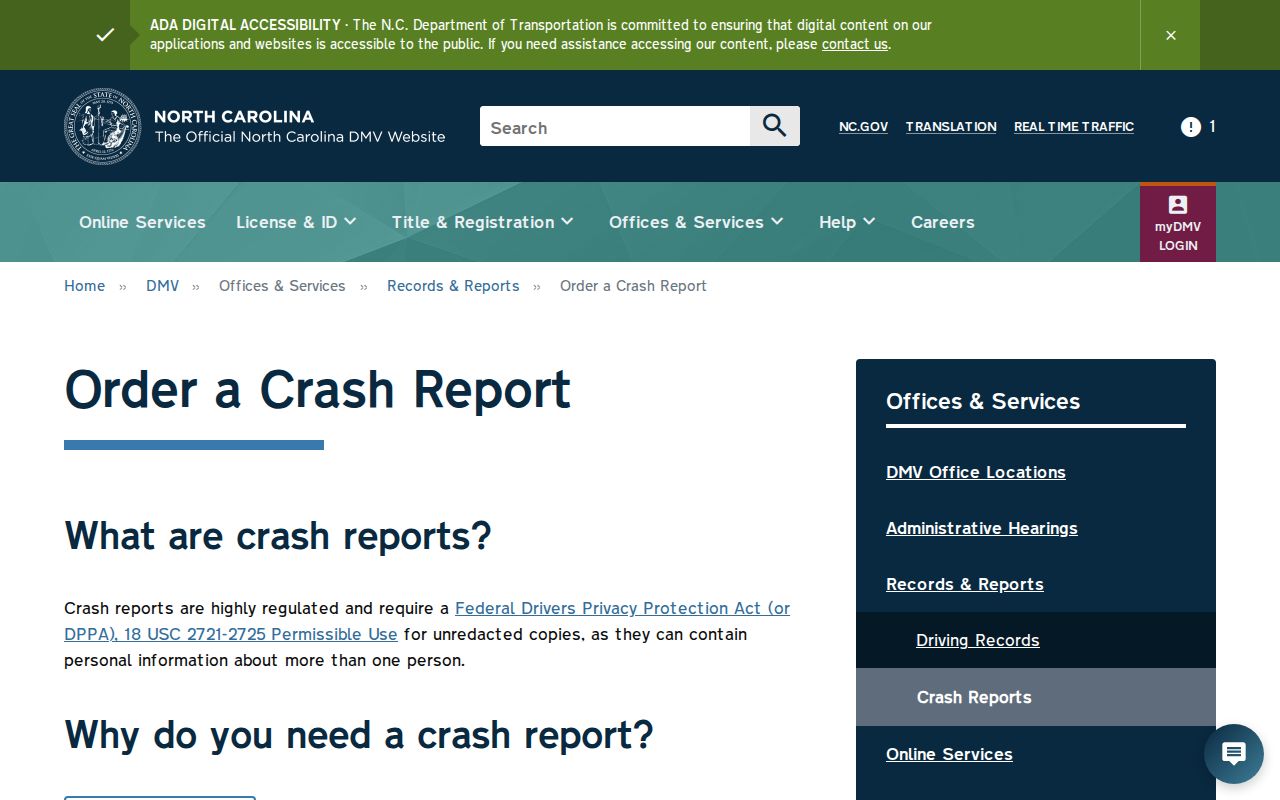
The image marks the separate NCDMV path, which should not be confused with a Laurinburg arrest report or Scotland County criminal case file.
Call 919-861-3098 for the state crash-report contact listed in the city research. If the event was not a qualifying crash, ask Laurinburg Police Records which local report exists and what can be released.
How Laurinburg Records Reach the County
A Laurinburg police event moves through systems as agencies complete different tasks. City staff retain the incident report and submit NIBRS data. Scotland detention records custody. The magistrate handles initial judicial process, while the clerk opens or updates the case. Reportable fingerprints and arrest data reach the North Carolina SBI, and the court disposition is linked back to the arrest cycle when reporting is complete.
Record flow: Laurinburg Police › Scotland County Courts › North Carolina State Bureau of Investigation
For a new Laurinburg incident, start with police or detention. For allegations, hearing dates, and final outcome, use eCourts and the clerk. For a question about how your own state history connects arrest and disposition, use SBI Right to Review.
Laurinburg Citation Record Timeline
Laurinburg Records staff enter traffic citations and can help a person locate a court date. Once the citation enters the state court system, the controlling case record is no longer a city-only file. The official Court Dates search accepts a name or case number and a county filter. Choose Scotland for a Laurinburg matter.
Timeline: Laurinburg citation › Scotland court calendar › District Court event › clerk disposition.
Calendar data can change. Confirm the date and courtroom through the clerk, especially when the Laurinburg record is recent or the online view looks incomplete. A scheduled setting should not be read as the case outcome.
Laurinburg Report Versus Court Record
A Laurinburg incident report describes what was reported and what city officers did. An eCourts file records what prosecutors filed and what the court decided. The two products overlap, but neither replaces the other. A report can exist without a filed charge. A filed charge can differ from the intake allegation. A case marked closed can include dismissal, conviction, or another charge-level result.
When a Laurinburg record appears inconsistent, compare the incident number with the court case number and obtain the charge-level disposition. If a court outcome is missing from your own SBI record, gather a certified disposition and follow the SBI correction process. Do not ask Laurinburg Police to certify a clerk judgment.
Note: A Laurinburg arrest is an enforcement event, not a court finding of guilt.
Laurinburg Police Record History
The city traces Laurinburg police service to the 1940s. Today’s published unit list shows how much the department has expanded beyond basic patrol. That history gives context to older records: a modern Police-Pak entry and NIBRS submission belong to a newer data workflow, while an older Laurinburg file may survive only as paper, archive material, or a clerk case.
For historical or genealogy work, provide Laurinburg Police or the clerk with a broad but usable date range, names, and known case or incident details. Ask whether the requested file is electronic, paper, archived, expunged, sealed, or otherwise restricted. The absence of an old Laurinburg record online does not prove that no record was created.
Laurinburg Record Access Rules
Laurinburg police records and Scotland court files follow different access rules. North Carolina Public Records Law applies to city-created records, but G.S. 132-1.4 protects criminal investigation and intelligence material while requiring release of specified basic information. Clerk records are generally open under G.S. 7A-109 unless another law restricts them. Juvenile records, victim information, sealed matters, expunged records, and sensitive identifiers can be withheld or redacted.
Key Statutes:
North Carolina Public Records Law, G.S. Chapter 132 requires access to public records while preserving statutory exemptions.
G.S. 7A-109 governs public inspection and certified copies of clerk records.
G.S. 15A-146 provides expunction routes for specified dismissed and not-guilty matters.
Ask Laurinburg Records for an identifiable existing record, not a custom analysis. If access is limited, request the public portion and the legal basis for any redaction.