
Criminal Court Cases in Scotland County
Scotland County criminal cases are heard in two divisions of the North Carolina General Court of Justice. Superior Court handles felony trials, felony pleas, sentencing, and qualifying appeals from District Court. District Court handles misdemeanors, infractions, first appearances, and preliminary felony matters. Both divisions sit within District 21. The Scotland County Clerk of Superior Court is the file custodian for both, so the word “Superior” in the clerk's title does not mean District Court files are held elsewhere.
The official Scotland County courts page provides the county's court services and calendar routes. Its captured view shows why the Judicial Branch page is a useful first check before a courthouse visit.
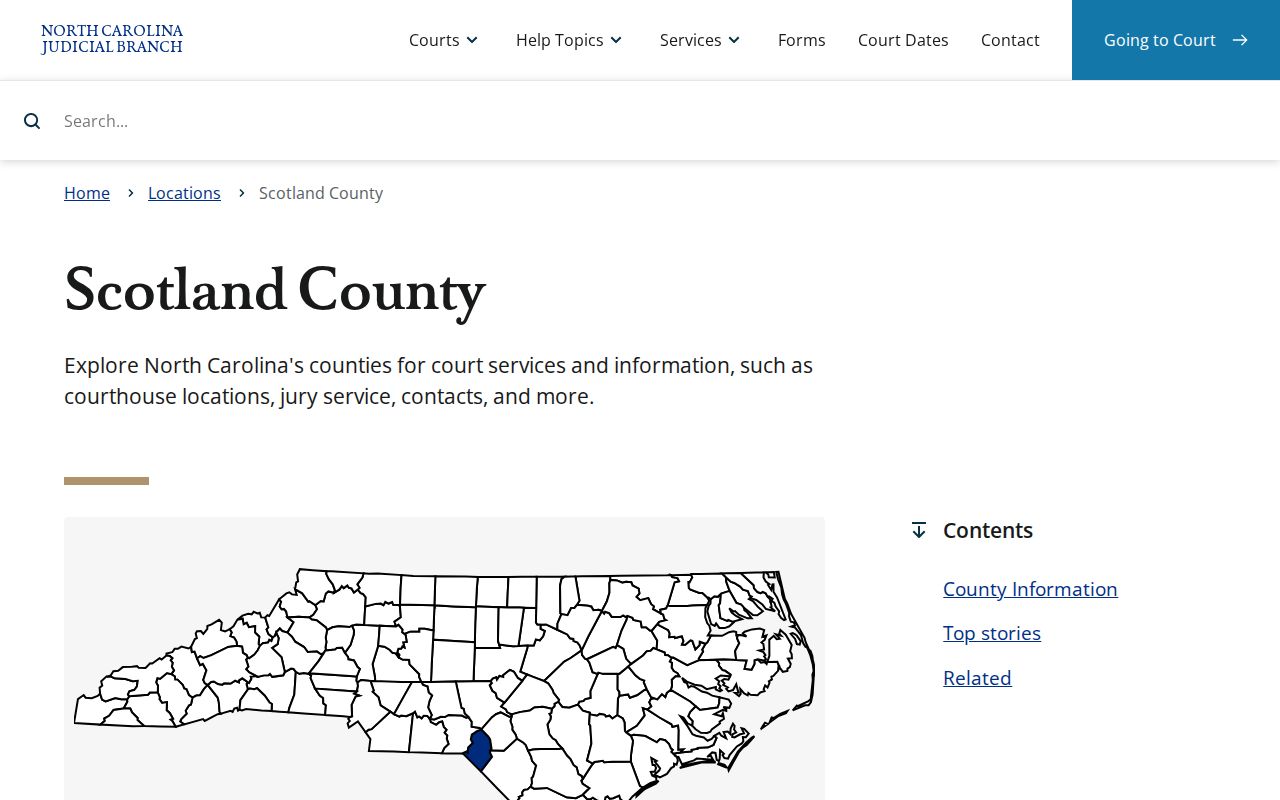
The county landing page ties local cases to the statewide court system rather than to a separate Scotland-only docket database.
Scotland County Court Divisions
A court division signals where a case is at that moment. A felony may first appear in District Court for an initial appearance or probable-cause stage, then proceed to Superior Court after indictment. A misdemeanor ordinarily remains in District Court. That path matters because a searcher who opens only one calendar may miss an earlier or later event in the other division.
| Court or office | Role in the case | Contact |
|---|---|---|
| Scotland Superior Court | Felony trials, pleas, sentencing, and qualifying appeals | Clerk: 910-266-4400 |
| Scotland District Court | Misdemeanors, infractions, first appearances, and preliminary felony matters | Clerk: 910-266-4400 |
| Magistrate | Initial process, warrants, custody review, and bond functions | 910-266-4540 |
| District Attorney, District 21 | Prosecution of filed criminal matters | 910-266-4500 |
The shared courthouse address can blur the lines between offices. The sheriff keeps agency reports, while the clerk certifies the docket and judgment. A deputy cannot certify a court disposition merely because the arrest occurred in Scotland County.
Scotland County Case Record Searches
Use the North Carolina eCourts Portal to locate a Scotland County case. Exact case numbers are the strongest identifiers. With a name search, narrow the location to Scotland and compare the filed date, division, charge, and available party details. Portal labels can change, and document images may not be public even when a docket entry is visible.
- Open eCourts Smart Search and enter the exact case number or a party name.
- Set the location to Scotland County and narrow the case category to criminal or infraction when that filter appears.
- Open the likely match, then compare division, filing date, charges, and event history.
- Check Court Dates separately for a scheduled setting because a calendar is not the full file.
- Call or visit the clerk for the judgment, pleadings, archived material, or a certified copy.
| Field label | Type | Required | Use |
|---|---|---|---|
| Search Criteria | Text | Yes | Party name or exact case number |
| Location | Filter | No | Select Scotland County to reduce unrelated names |
| Case Category or Type | Filter | No | Narrow to available criminal or infraction records |
| Filed Date From/To | Date | No | Limit results to an expected filing period |
| Case Status | Filter | No | Open, active, disposed, or closed where available |
An online miss is not the final answer. Older Scotland County files can require staff retrieval, and a visible docket may omit the document image needed to interpret an event. Give the clerk the case number, defendant name, and approximate filing year, then specify whether a plain copy, certified judgment, or full file is needed.
Scotland County Court Dates
The Judicial Branch's Court Dates search is a calendar channel. It accepts a defendant name with a county choice or an exact citation or case number in the alternate search mode. A date shown there proves that a matter is scheduled. It does not reveal every filing, establish the result, or amount to a criminal history.
Use the setting to plan a follow-up, then return to the case events or ask the Scotland County clerk what happened after the scheduled hearing.
Common names need extra care. Compare the case number and county first. Then check the filing date and charge. The Court Dates tool is most useful alongside eCourts, not as a replacement for it.
What a Criminal Case File Contains
A Scotland County court file is case-centered. It records what was filed and how each charge moved. The file can show a dismissal on one count and a conviction on another, so the final result must be read at charge level. A broad case status such as “closed” says only that the case is no longer active in the same way. It does not state why it closed.
| Case number and court | County, division, category, filing date, type, and status. |
|---|---|
| Parties | State and defendant display, plus attorney information when public. |
| Charge record | Description, date, statute or class when entered, count, and any amendment. |
| Docket events | Process, appearances, hearings, continuances, plea, verdict, dismissal, and appeal entries. |
| Disposition and judgment | Charge-level outcome, judgment date, and the court's formal result. |
| Sentence and financial data | Publicly shown terms, costs, fines, restitution, or balances, with protected data redacted. |
Document access varies. A docket may name an order without displaying its image. Ask the clerk for that specific document and state whether a plain or certified copy is needed.
Scotland County Criminal Case Copies
The clerk's counter is the fallback when the electronic file is incomplete, archived, or missing an image. Supply the case number when possible. Otherwise, give the defendant name and an approximate filing year. Ask whether the case is electronic, paper, archived, sealed, or subject to another access limit. That focused request is more useful than asking staff to research an open-ended personal history.
The official courthouse contact directory identifies the local clerk, judicial offices, prosecutor, magistrate, and court staff.
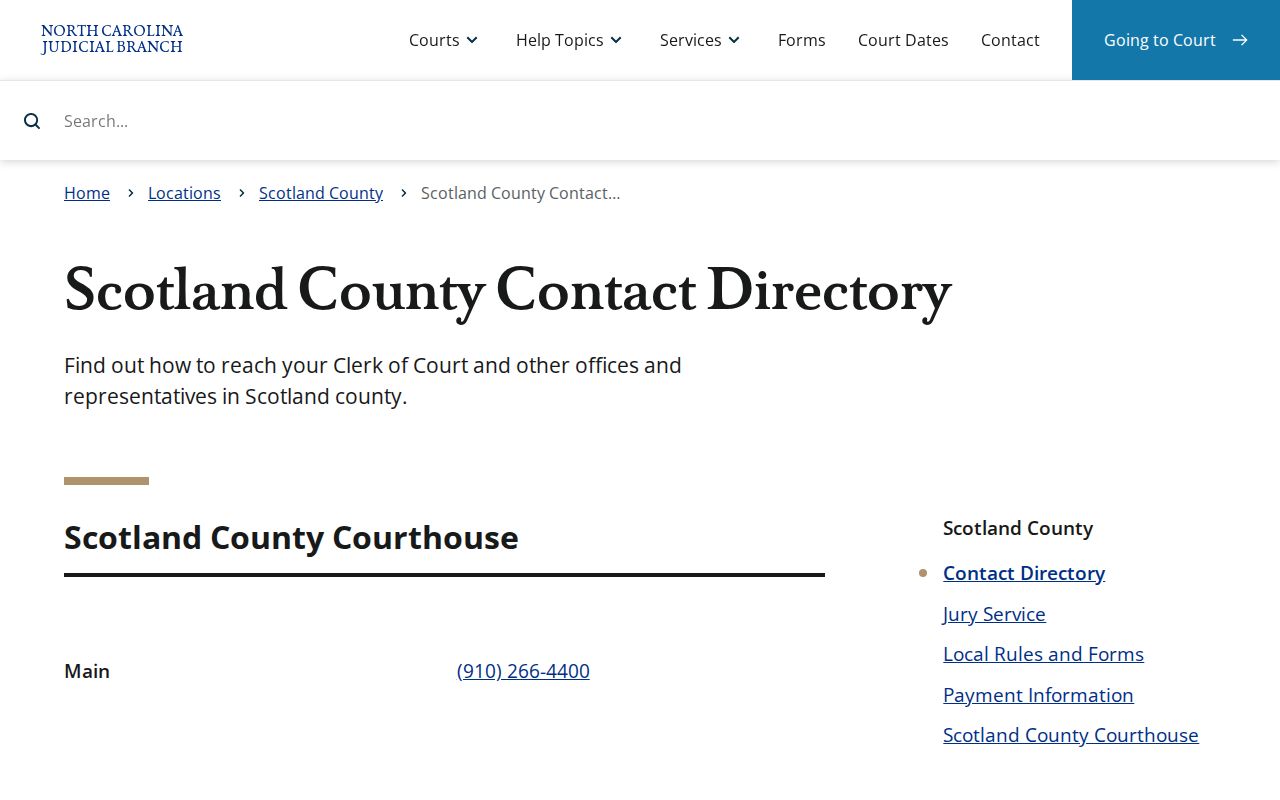
This directory helps route a record request to the clerk rather than to the prosecutor, magistrate, or sheriff.
Scotland County Clerk of Superior Court
212 Biggs Street
Laurinburg, NC 28352
910-266-4400
Call first to confirm the counter, access, and copy or certification process.
Criminal Case Stages in Scotland County
A Scotland County case begins with formal process and filed charges, not with a final conclusion. District Court commonly handles the first appearance and early felony steps. An indictable felony then moves into Superior Court. Misdemeanors usually stay in District Court. Motions, continuances, plea talks, and hearings can add events before a charge reaches trial, dismissal, plea, or another disposition.
Case flow: Charges Filed › Arraignment › Pretrial › Plea or Trial › Disposition › Sentencing
Each arrow may create a docket entry, but not every event ends a charge. “Arraignment” is the stage where charges are formally addressed and a plea may be entered. “Disposition” is the outcome. A judgment follows a conviction and states the court's formal adjudication and sentence.
Scotland County Case Outcomes
Read each count separately. A charge can be amended, dismissed, resolved by plea, tried to a verdict, or carried into another file. A nolle prosequi refers to a prosecutor's decision not to proceed where that label is used, though North Carolina records often display a dismissal. An acquittal is a not-guilty result after adjudication. None of those terms means the same thing as a conviction.
- Disposition
- The recorded outcome for a charge or case.
- Indictment
- A grand jury's formal felony accusation, not proof of guilt.
- Order for arrest
- North Carolina process that may issue after a failure to appear or another statutory event.
- Prayer for judgment continued
- A North Carolina result that postpones entry of judgment; its consequences depend on context.
A sentencing label also needs context. North Carolina's structured sentencing depends on the offense class, prior-record level, findings, and the judgment. The offense class by itself does not supply the whole penalty.
Scotland County Court Service Routes
The North Carolina Judicial Branch services page links record, citation, payment, and calendar functions used for Scotland County cases.
Choose the service that matches the task. Payment does not replace a docket search, and a calendar result does not replace the judgment.
Federal matters use a separate system. Scotland County lies in the Middle District of North Carolina, and federal dockets are searched through PACER. Federal custody is also distinct from county detention or NCDAC custody.
The Federal Bureau of Prisons locator is the official federal custody channel.
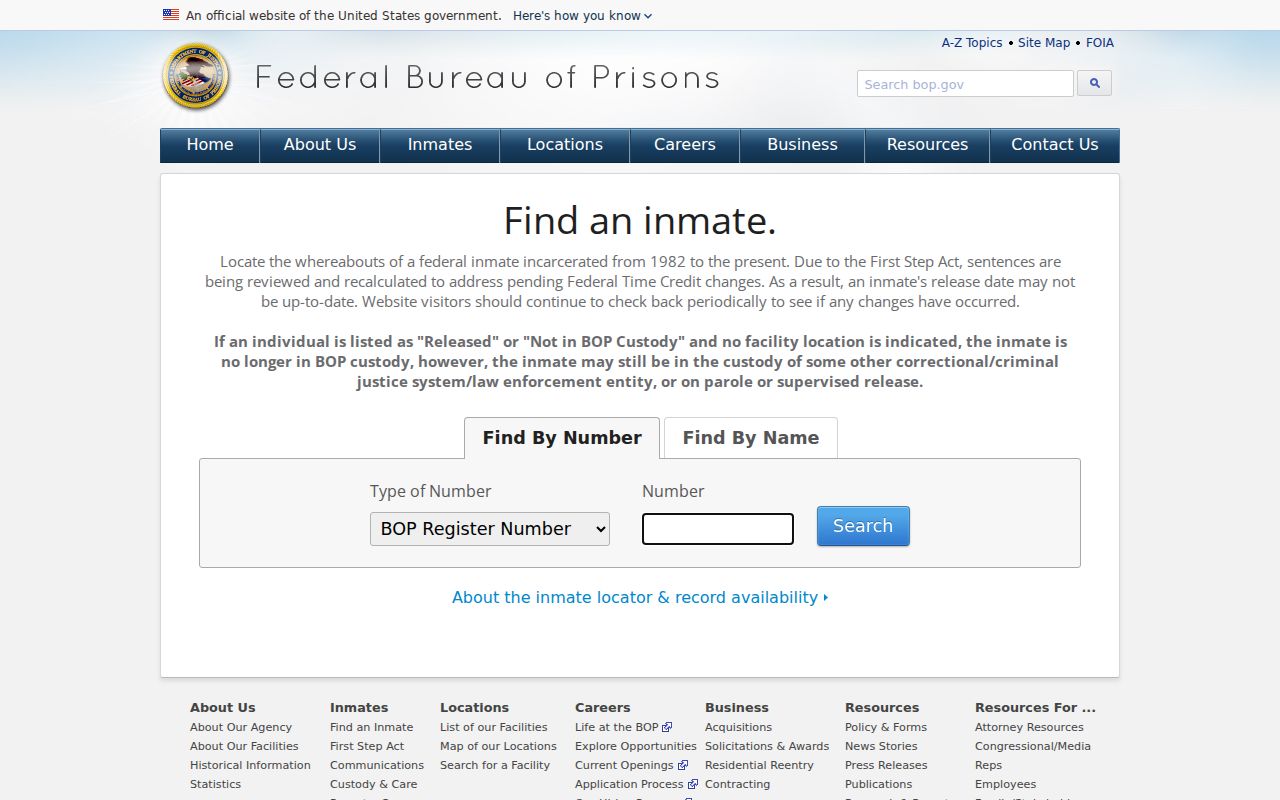
Its result is a custody record, not the Scotland County criminal court file and not a federal docket.
Access Rules for Case Records
Clerk records are generally open to inspection under G.S. 7A-109, except when another law restricts access. Juvenile matters, expunged records, protected victim information, sealed filings, and sensitive identifiers do not become public merely because related adult cases are searchable. Online displays may redact more than the paper file or omit an image while still listing the event.
Agency reports follow a different access rule. G.S. 132-1.4 limits broad access to criminal investigation and intelligence material, while requiring disclosure of certain categories of basic incident and arrest information. A sheriff request is therefore not the proper route to a clerk's case file.
When a Scotland County result is absent, ask the clerk whether it is archived or restricted. When an online entry conflicts with a certified judgment, preserve the case number and obtain the official disposition before seeking a correction. The broader Scotland County criminal history overview explains the separate SBI self-review channel.
Note: A calendar setting, filed charge, or indictment is not a conviction; only the disposition and judgment establish the recorded outcome.